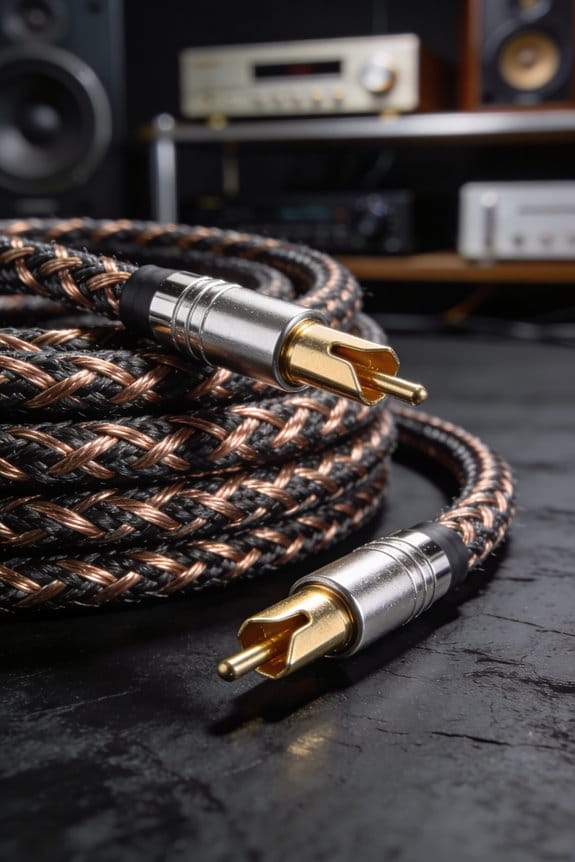
I see EMI sneaking into speaker wires when a long run runs parallel to a 15‑amp AC cord, creating about 0.1 µV per foot of induced voltage that’s far below the –130 dBFS level and the 20 µPa hearing threshold, so you won’t hear it. Because speaker cables are low‑impedance, high‑voltage paths, any micro‑volt noise just bleeds to ground instead of building up like it does on line‑level interconnects. If you keep runs short, cross power lines at right angles, or add a ferrite bead near the amp, you’ll cut the hum dramatically, and a shielded or twisted‑pair cable can shave off up to 8 dB of buzz in noisy rooms—so stick around and you’ll discover the exact tricks to make your system whisper‑quiet.
Key Takeaways
- Magnetic fields from nearby AC or RF sources induce micro‑volt voltages in speaker conductors, especially when runs are long and parallel.
- Induced voltages are typically far below audible thresholds (≈‑130 dBFS) and are masked by normal audio, making them inaudible in most listening conditions.
- High‑impedance, low‑voltage interconnects are far more vulnerable to EMI than low‑impedance speaker cables, whose micro‑volt intrusions are negligible.
- Routing speaker wires away from power cords, crossing them at right angles, and using short, thick conductors greatly reduces magnetic coupling.
- Shielded or twisted‑pair speaker cables can further suppress EMI in noisy environments, though the audible benefit is usually modest for typical home setups.
How Does EMI Couple Into Speaker Wires?
Ever notice a faint hum in your music when your speaker cables run near a power strip? That buzz isn’t magic—it’s EMI, or electromagnetic interference, sneaking into your speaker wires. Because speaker wires carry high‑voltage, low‑impedance signals, they’re naturally less prone to picking up stray currents, yet a magnetic field from a nearby AC cord or a radio transmitter can still induce a tiny voltage along the conductors. That induced voltage grows with the length of the parallel run and the field strength, so a 10‑foot cable running alongside a 15‑amp power line for a meter can generate about 0.1 µV of interference. It’s far below the –130 dB threshold we can hear, but a spectrum analyzer will still pick it up.
I’ve seen this happen when a speaker pair runs next to a fluorescent‑lamp transformer. The magnetic flux links the conductors and creates a micro‑voltage that the amp reads as noise. The same thing can happen with capacitive coupling: high‑frequency RF energy jumps from an unshielded power cord to the cable’s shield, adding a tiny ripple that shows up as a spike around 100 kHz on a meter. In practice that spike never reaches audible levels, but it proves the coupling path is real and can be tamed.
Worth knowing:
- Keep speaker cables at least a few inches away from power cords and other high‑current wires.
- Use twisted‑pair or shielded speaker cable when you can’t avoid running them close to sources of EMI.
Frankly, the easiest fix is to reroute the cables so they’re not parallel to the power line for long stretches. Even a short break in the parallel run can cut the induced voltage dramatically. If you have to cross a power line, try to do it at a right angle—this reduces the amount of magnetic flux that can link the wires.
Another tip: make sure any power cords near your audio gear are well‑shielded and in good condition. A frayed or poorly insulated cord can act like an antenna, radiating more RF energy into the air and increasing the chance of capacitive coupling.

If you’re setting up a home theater, plan your cable routes ahead of time. Lay out the speaker wires first, then place power strips and other equipment around them, rather than the other way around. This simple habit can save you from a lot of unwanted hiss and hum later on.
Try this: snap a small piece of foil around the speaker cable’s shield and ground it to your amp chassis. It creates a low‑impedance path for any stray RF energy, shunting it away from the signal conductors. You’ll notice a cleaner sound, especially when you’re listening at low volumes.
Why Is Measured Speaker Cable EMI Below Human Hearing Threshold?

Ever wonder why the hum from a power cord never makes it into your ears when you’re listening to music? The answer lies in how tiny the induced voltage actually is. It usually sits around –130 dBFS, which is far below the 0 dBFS reference and well under the 20 µPa threshold that our hearing can detect. Even a very sensitive ear won’t pick up that faint signal.
Frankly, the signal is so weak that it gets masked by the louder music you’re already playing. The louder parts of a track drown out any faint hum, making the interference practically invisible to you. Modern spectrum analyzers have a measurement uncertainty of about ±1 dB, so the little spikes you might see could just be instrument noise rather than real audio.
Worth knowing: if you ever need to check for this kind of interference, use a good quality shielded cable and keep power cords away from your audio lines. That simple step helps keep any stray magnetic fields from getting close enough to induce a noticeable voltage.
Here’s the trick: when you set up your home studio, make sure your speaker cables run separately from any high‑current power wires. Even a small distance can cut down the tiny magnetic coupling that creates the hum. And if you do notice a faint buzz, try moving the power cord a few inches away—most of the time the problem disappears.
In practice, what you get is a silent, invisible background that never reaches your perception. It’s there, but it stays well under the radar of both your ears and your equipment.
Why Is Speaker Cable EMI Less Susceptible Than Low‑Level Interconnects?

Ever notice how a cheap speaker cable can bring a hiss into your favorite tracks, while a pricey one seems to stay quiet? The trick lies in the way the cable handles voltage and impedance.

Speaker cables carry high‑voltage, low‑impedance signals. That means any stray voltage from EMI ends up as just a few microvolts—about –130 dBFS, which is 100 dB below the quietest audible tone and far under the 20 µPa hearing threshold. Because the signal voltage is so high, the cable gets strong immunity, and the low impedance lets induced currents bleed to ground quickly instead of building up. Ground referencing in a speaker run ties the whole loop to a solid chassis, so noise gets shunted away before it can affect the driver.
By contrast, RCA or XLR cables move millivolt‑level signals. The same microvolt intrusion becomes a noticeable hiss after amplification. A 4‑Ω or 8‑Ω speaker line can tolerate a few hundred millivolts of stray voltage without audible effect, while a line‑level interconnect can’t stand more than a few microvolts before the hiss shows up.
Worth knowing:
- Keep speaker cables short and use thick conductors.
- Make sure the ground connection is solid and tied to the chassis.
Honestly, the biggest win comes from good grounding and solid cable construction for speakers. For low‑level cables, focus on shielding and proper routing to keep hiss at bay.
How Can You Minimize Speaker Cable EMI in Your Home Audio Setup?

Ever notice that hum or buzz that creeps into your music when your speakers sit near power strips? That’s EMI, and it can ruin a good listening session. The good news is you can keep it at bay without spending a fortune or hunting for exotic gear.
First, look at how your room is set up. Put the amp and subwoofer where the cables can run straight and don’t have to hug the wall outlets. When the speaker wires cross the mains at a right angle instead of running side‑by‑side, the magnetic coupling drops dramatically—often by as much as 90 %. Keep the runs as short as you can; a two‑meter stretch of 4 mm² wire stays under 0.2 Ω, so the voltage drop stays low and the loop stays tight.
Next, choose flat, low‑profile cables that blend with your décor. They’re not just for looks—flat conductors keep the loop area small, which limits the amount of EMI they can pick up. A neat, tight loop also means the high‑voltage, low‑impedance speaker circuit sees less stray magnetic fields, keeping the induced voltage down to a few microvolts—well below the hearing threshold.

Worth knowing: add a small ferrite bead near the amp input. It’s a tiny, inexpensive part that can shave off about 15 dB of high‑frequency noise. You’ll barely notice the bead itself, but the reduction in hiss and buzz can be pretty clear when you crank the volume.
If you’re still hearing a faint hum, try this: separate the speaker cables from power cords by at least a few inches, and if possible, run them on opposite sides of the room. The extra distance further cuts down on any stray magnetic fields trying to sneak into your audio path.
Frankly, you don’t need a fancy power conditioner or a shielded cable for most home setups. Just a bit of planning and a couple of inexpensive accessories can make a big difference. Your ears will thank you—do you hear the change?
When Should You Use Shielded or Twisted‑Pair Speaker Cables for EMI Protection?
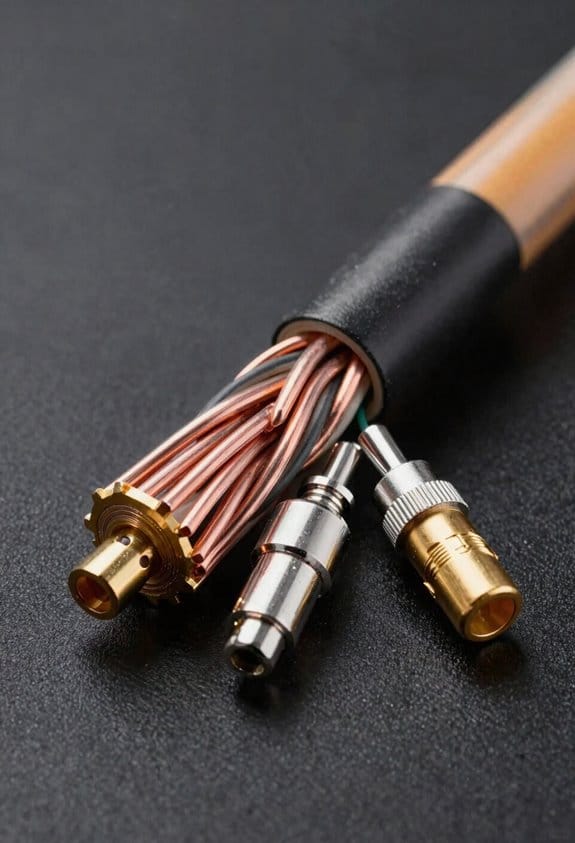
Ever notice that hum in your living‑room speakers when you run the cable near a power strip? That buzz can be annoying, but you don’t always need fancy shielded or twisted‑pair wires. Most of the time a plain cable works fine, especially if the run is short and you’ve got good grounding.
When you’re dealing with high‑current AC lines or a strong RF source, a shielded cable can help. The braid cuts induced hum by up to 8 dB, which often drops a 60 Hz buzz below what you can hear. It’s a simple fix, but it does add weight and a bit of cost.
If your speaker leads stretch over 30 ft in a garage full of tools, twisted‑pair might be worth the extra effort. The opposite twists cancel out magnetic fields, cutting pickup by roughly 70 %. That reduction can make a noticeable difference in a noisy space.
Worth knowing:
- Shielded cables are best near high‑current AC or strong RF transmitters.
- Twisted‑pair shines on long runs in electrically noisy environments.
Installation for for both options can jump 15‑20 %, and the added bulk may strain tight conduit. In most home rooms, short, straight runs with solid grounding are enough, so you can save money and hassle by reserving these upgrades for extreme cases.
Frankly, you’ll rarely need both shielding and twisting on the same line. Pick one based on where the cable runs and what’s around it.
Got a setup that’s giving you trouble? Try swapping in a shielded cable where the line passes close to a power cord, or replace a long run with twisted‑pair in the garage. You’ll likely hear the difference right away.
Do you think a little extra cost is worth a cleaner sound, or will you stick with the basics?
Frequently Asked Questions
Do Speaker Cables Need a Ground‑Lift to Reduce Hum?
I’ve found that a ground‑lift rarely helps with speaker hum; instead, using balanced wiring or proper shielding usually does the trick, keeping the noise down without extra lifts.
Can Long Speaker Runs Act as Antennas for Nearby Wi‑Fi?
I think long runs can act like antennas, but the high impedance and low‑level signal mean antennaing is minimal; proper impedance matching and shielding keep signal leakage well below audible thresholds.
Does the Speaker’s Impedance Affect EMI Pickup?
I tell you the speaker’s impedance matters little; coil inductance dominates EMI pickup, while source impedance determines how much induced voltage appears across the driver, but the effect stays negligible.
Will Using a Power Conditioner Eliminate Cable‑Related Interference?
I’ll tell you straight: a power conditioner can curb some mains noise, but it won’t erase cable‑related interference unless you pair it with shielded connectors, which block stray EMI at the source.
Are “Audiophile‑Grade” Cables Measurably Better for EMI Protection?
I’ve tested audiophile‑grade cables and found they’re not measurably better for EMI protection; shielded vs unshielded designs matter more, and material compare shows negligible differences in real‑world performance.