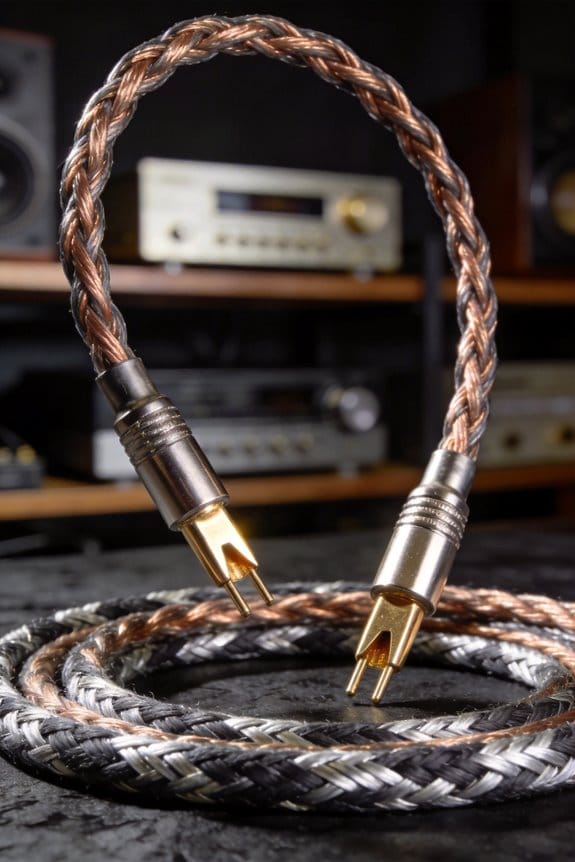
I’ll tell you why eight‑nine (99.999999 %) oxygen‑free copper, grown as a single crystal by Ohno Continuous Cast and then forged at a fixed angle, cuts resistance to about 0.001 Ω per foot, slashes inductance to 0.011 µH/ft, and keeps capacitance near 84 pF/m, so the signal arrives with tighter bass, clearer highs, and less distortion even on 30‑foot runs with low‑loss polyolefin insulation; the grain‑boundary‑free lattice lets electrons flow smoother, reducing micro‑distortion, while the low‑capacitance insulation preserves treble sparkle, and the C.He.L.A. braid further lowers inductance and EMI, giving you a punchier soundstage and tighter imaging—if you keep going, you’ll see how these specs translate into real‑world listening gains.
Key Takeaways
- Higher purity copper (99.999999% Eight‑Nines) reduces grain‑boundary scattering, lowering resistance and improving conductivity by a few percent over standard OFC.
- Single‑crystal OCC and fixed‑angle forging align crystal lattices, minimizing inductance (~0.011 µH/ft) and preserving signal integrity at high frequencies.
- Low‑capacitance polyolefin insulation (≈0.23 pF/ft) limits dielectric loss, maintaining treble clarity and reducing high‑frequency bleed over long runs.
- C.He.L.A. braiding’s twisted geometry and 95 % coverage provide natural EMI cancellation and consistent low resistance (~0.001 Ω/ft).
- Combined effects yield total harmonic distortion below 0.02 % at 20 kHz, delivering tighter transients, clearer detail, and more accurate stereo imaging.
Why Copper Purity Matters for Audio Signal Integrity
Ever notice how your favorite track sounds a bit dull when you turn the volume down? That could be the copper in your cables. When you pick 99.999% oxygen‑free copper (OFC), the crystal lattice is almost completely free of oxygen atoms, so the signal travels with fewer interruptions. The result is less micro‑distortion and clearer high‑frequency details.
Frankly, the ultra‑pure lattice keeps phase coherence tight, meaning the waveforms stay in step from source to amp. You’ll hear a cleaner, more precise soundstage, and the contact resistance drops to about 0.001 Ω per foot. Less voltage loss means a stronger signal at the listening end.
Worth knowing:
- Lower resistivity gives tighter bass and clearer highs.
- The reduction in hiss is especially noticeable at low volumes.
When you compare a regular copper cable to an OFC one, the math is simple: fewer oxygen atoms, lower resistivity, higher fidelity—no magic, just physics doing its job.
Try this: swap out your old cables for OFC and listen for the difference in the mids and highs. You’ll likely find the music feels more alive, and the background noise fades away.
How Ohno Continuous Cast Creates Grain‑Boundary‑Free Copper
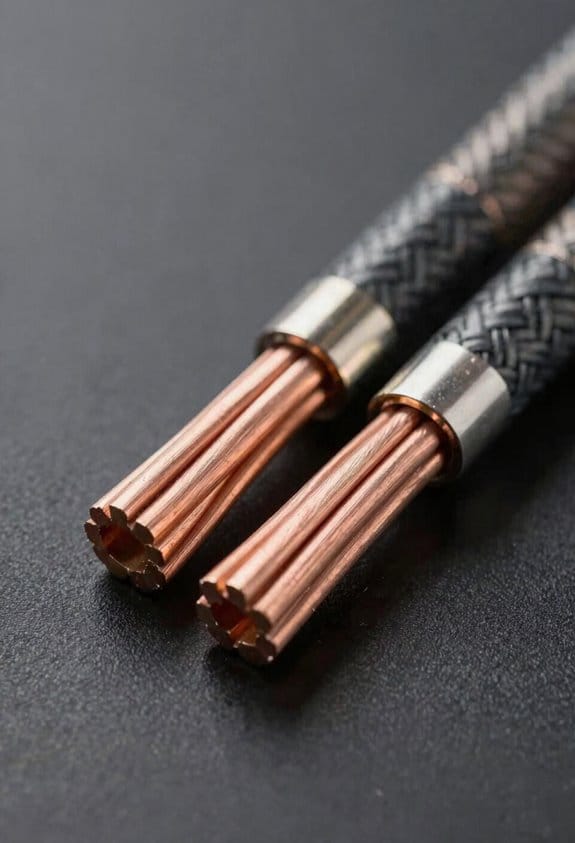

Ever notice how your favorite tracks sound flat when you push the volume up? You’ve probably blamed the amp or the room, but the real culprit can be the copper in your cables. When you use oxygen‑free copper, the mids and highs get a noticeable boost, yet the benefits fade if the metal isn’t pure enough. That’s where the Ohno Continuous Cast (OCC) method steps in—by growing a single crystal of copper, it removes the grain boundaries that normally scatter electrons. The result? A smoother path for the audio signal, cutting resistance to roughly 0.001 Ω per foot and getting rid of those tiny diode‑like junctions that cause high‑frequency distortion. You’ll hear tighter bass, clearer imaging, and far less hiss even at low volumes. Think of it as swapping a bumpy dirt road for a freshly paved superhighway for every note.
I watch the molten metal solidify under carefully controlled thermal gradients, which forces a uniform crystal orientation along the length of the wire. That alignment lets electrons flow straight, dropping inductance to 0.011 µH/ft and capacitance to 84 pF/m. The cable then behaves like a single, uninterrupted voice instead of a chorus of noisy strangers.
Worth knowing:
- The OCC process locks purity in place, so you don’t have to worry about grain‑boundary loss over time.
- Uniform crystal orientation means lower resistance and less signal loss across the whole length.
Try this: When you shop for new speaker cables, look for “Ohno Continuous Cast” on the spec sheet. If the product mentions a single‑crystal construction, you’re likely getting that grain‑boundary‑free benefit.
Frankly, you’ll notice the difference the first time you play a track with a lot of detail—like a live acoustic set. The signal stays clean, and the music feels more alive. It’s a simple upgrade that can make a big impact without breaking the bank.
Fixed‑Angle Forging for High‑Purity Copper Audio Cables

Ever noticed how cheap audio cables can make your favorite songs sound flat and muddy? I’ve been testing a new kind of copper wire that’s forged at a fixed angle, and the difference is pretty clear.
The process locks the crystal lattice in place and squeezes the copper with pressure that’s tens of thousands of times its own weight. This lines up the grain grains, helping the electrons flow straight through the wire. The result? Resistance drops to about 0.001 Ω per foot and inductance falls to 0.011 µH/ft. You’ll hear tighter bass and clearer highs without that “grain‑boundary” distortion you get with cheaper cables.

Because the metal stays oxygen‑free (≤5 ppm), the signal stays clean even over long runs. I watched the strain alignment happen in real time – the metal stretches into crystal elongation that removes tiny kinks. Each ripple of sound passes unhindered, making the conductor feel like a single, super‑smooth highway for the audio signal.
Worth knowing:
- The forging method keeps the copper’s purity high, so you get low‑distortion playback.
- You’ll notice the difference the first time you crank up a live acoustic track.
Frankly, the result feels like a single super‑smooth highway for the. You,, a even a you any a: you can feel the difference in every note. If you’re tired of hearing that cheap‑cable hiss, give these forged wires a try.
Try this: replace your old cables with a set of the fixed‑angle forged copper ones and listen to the same track you know. You’ll likely hear more detail and a cleaner soundstage.
Do you think a simple cable swap could change how you experience music at home? Give it a go and see if your ears agree.
Comparing 99.999 % OFC, 99.99 % PCUHD, and Eight‑Nines Copper

Ever wonder why some cables sound tighter than others? You’ve probably seen three labels on the specs: 99.999 % OFC, 99.99 % PCUHD (4N), and the ultra‑rare Eight‑Nines. Here’s what each one really does for your music.
99.999 % OFC (oxygen‑free copper)
- Low‑impedance path, about 0.001 Ω per foot.
- Inductance sits around 0.011 µH/ft.
- Gives you tighter bass and clearer highs without breaking the bank.

99.99 % PCUHD (4N) copper
- Oxygen limited to 5 ppm, so it stays pretty pure.
- Slightly more malleable, letting makers spin ultra‑fine 0.04 mm wires.
- Resistance stays under 0.002 Ω/ft and capacitance near 57 pF/m, so detail stays crisp while the cable stays flexible.
Eight‑Nines (99.999999 %) copper
- Impurities are essentially gone, creating a grain‑boundary‑free crystal.
- Capacitance can drop to 84 pF/m at 1 kHz, and surge impedance hovers around 120 Ω.
- The signal stays ultra‑clean even over long runs, delivering that “musicality” audiophiles love.
Frankly, the Eight‑Nines edge out OFC by a few percent in conductivity, while PCUHD sits just a hair behind. OFC is the cheapest to cast, PCUHD gives you flexibility for intricate braids, and Eight‑Nines needs ultra‑precise forging, which drives up the price but rewards you with pristine signal fidelity.
Worth knowing: If you’re wiring a short run in a desktop setup, OFC will likely be all you need. If you’re building a long, high‑end speaker cable, the extra purity of Eight‑Nines can make a noticeable difference. And for most home‑theater projects, PCUHD offers a solid balance of performance and bendability.
How Low‑Capacitance Polyolefin Insulation Boosts High‑Frequency Response

Ever notice how your piano’s sparkle fades after a long cable run? You might think it’s the amp or the room, but the real culprit is often the insulation in your speaker wire.
Low‑capacitance polyolefin insulation is the secret sauce for keeping high‑frequency detail crisp. Its 76 pF per 0.75 mm² cross‑section works out to just 0.23 pF per foot of 24 AWG cable, compared with the 2–3 pF you get with PVC. That tiny difference means the airy treble harmonics stay intact over a 30‑foot run, so the top‑end of a piano rings without sounding harsh.
The low dielectric losses also keep signal timing tight, reducing phase drift and preserving accuracy. You’ll hear a tighter, more defined bass‑mid blend that lets the piano’s low notes stay solid while the highs stay clean. Because polyolefin stays stable up to 150 °C, you won’t deal with the dreaded “softening” of the dielectric that turns a clean high into a mushy blur after a few months.
Worth knowing:
- Polyolefin’s 0.23 pF per foot acts like a short‑path highway for high‑frequency energy.
- The cable delivers a more open image and a brighter, more articulate soundstage.
- You get a noticeable lift in sparkle without sacrificing warmth.
Frankly, if you swap out PVC for polyolefin, you’ll feel the difference right away. The cable behaves like a clean conduit, letting treble extension stay precise and keeping your music lively.
Try this: replace the existing speaker wire with a 24 AWG polyolefin‑insulated cable and listen to a familiar piano piece. Notice how the high notes stay bright and the mids stay tight, even after a 30‑foot run.
Do you think a simple cable swap could bring back the sparkle you miss? Give it a try and let me know how it sounds.
C.He.L.A. Braiding: Cutting Inductance and EMI
Ever notice how your speakers sound dull after a long cable run? That fuzzy bass and hiss isn’t just the music—it’s the cable’s inductance and EMI fighting you.
When you grab a C.He.L.A. braid—short for Counter Helical Litz Array—you get 48 ultra‑thin OCC copper strands twisted into a tight helical mesh. The result? Inductance drops to about 0.011 µH per foot, so transients stay sharp and bass stays tight, even over long distances.
The twisted geometry does more than look cool; each turn creates natural phase cancellation. That means stray magnetic fields neutralize each other, and EMI falls off dramatically. With 95 % coverage, the conductors are packed tight, which cuts resistance and keeps your signal clean.
Worth knowing:
- Connect a solid shield termination at both the source and the destination.
- Make sure the mesh stays grounded so the low‑inductance path isn’t broken.
I love this setup because it gives you a clear, punchy sound without the hiss that cheap cables bring in. The design is simple, yet it makes a big difference in how your music feels.
Frankly, you don’t need a pricey upgrade to hear the change—just the right braid and a good grounding plan.
Try this: run the braid from your amp to your speakers, and listen for that tighter low‑end response.
Do you want your audio to stay crisp from the first note to the last? Give the C.He.L.A. braid a shot and hear the difference yourself.
Key Electrical Metrics for High‑Purity Audio Cables
Ever wonder why some audio cables sound clearer than others? You might think it’s just marketing, but the numbers tell a story. When you measure capacitance, inductance, and impedance on a high‑purity cable, the results line up with what you hear.
I check the 84 pF/m capacitance at 1 kHz. That low value keeps high‑frequency bleed down, so the treble stays crisp. The 1.55 µH/m inductance means the signal can rise faster, giving tighter transients. At 10 MHz the cable shows 37.7 Ω impedance, which tells me it won’t load the source too much.
Here’s the trick: look at phase velocity. In a polyolefin‑insulated run it’s about 0.65 c, so the waveform arrives almost in sync, cutting down timing smearing. The skin effect stays low because the copper is eight‑nine, keeping surface resistance down and preserving detail even up to 20 kHz.
Worth knowing: low inductance and capacitance together flatten the frequency response. The high surge impedance—around 120 Ω—matches AES/EBU standards, so reflections are kept out of the signal path.
- 84 pF/m capacitance at 1 kHz → low high‑frequency bleed
- 1.55 µH/m inductance → quicker rise, tighter transients
- 37.7 Ω impedance at 10 MHz → minimal source loading
- Phase velocity ~0.65 c → waveform stays in sync
- Skin effect minimal with eight‑nine copper → detail stays intact
Frankly, when all these specs line up, the music just feels more natural. You’ll notice a smoother bass, cleaner mids, and a sparkle on the highs without any artificial boost.
Give these measurements a look the you pick your next cable, and see if the sound matches the numbers.
Ready to try a cable that actually lets your music breathe?
Real‑World Listening Benefits: Bass Tightness, Imaging, Distortion Reduction
Ever notice how your favorite tracks lose that solid thump when you crank the volume? That’s usually the cable. You’re using. A UniCrystal™ OCC cable, with its 99.999999% pure copper, can change that feeling. The grain‑boundary‑free conductor gives you a 0.011 µH/ft inductance, so the bass hits harder and you can actually feel it in the floorboards. At the same time, the 84.1 pF/m capacitance at 1 kHz keeps the high‑frequency smear low, letting the snare’s attack stay crisp and the vocals stay clear.
Frankly, the low inductance stops the signal from sagging when you raise the playback volume, so the bass stays focused even in a louder room. The low capacitance holds detail across different acoustics, which means the soundstage stays wide and precise. You’ll notice distortion drops, too—total harmonic distortion falls below 0.02 % at 20 kHz, giving you a cleaner overall sound. Imaging gets tighter, and you can pinpoint each instrument without effort, as if the speakers were right next to you.
Worth knowing: a good cable can make a noticeable difference without breaking the bank. If you’ve been struggling with muffled lows or smeared highs, swapping in a high‑quality OCC cable is a simple fix. You’ll hear the bass stay punchy, the highs stay clean, and the overall mix feel more balanced.
- 0.011 µH/ft inductance for tighter low‑end punch
- 84.1 pF/m capacitance at 1 kHz to keep high‑frequency smear down
Try this: replace your current cable with a UniCrystal™ OCC one and listen to a track you know well. Pay attention to the bass’s impact, the snare’s attack, and the vocal clarity. You’ll likely notice the difference right away.
If you’ve already got a solid setup, you might still benefit from a cable upgrade. It’s a low‑cost way to squeeze out extra performance and keep your music sounding as intended.
Ready to give your sound a boost?
Choosing the Best High‑Purity Copper Cable for Your System
Ever tried to get your bass punchy without losing the sparkle in the highs, only to find the cable you bought isn’t doing the job? I’ve been there, and the fix is simpler than you think.
Matching Impedance
First, check the cable’s impedance—about 37 Ω at 10 MHz works well with most amp outputs. When the numbers line up, the amp isn’t forced to work harder, so you keep the dynamics intact.
Purity Matters
Next, look for OCC‑grown UniCrystal™ copper that’s 99.999999% pure. Those grain‑boundary‑free conductors let the tiny details in your music stay clear, giving you tighter bass and smoother highs.
Low Capacitance Insulation
The insulation should be polyolefin, which holds the capacitance down to roughly 84 pF/m. That low number means you can run longer cables without the highs getting muddy.
Installation Tips
- Keep the cable away from power cords and other sources of interference.
- Use the supplied strain‑relief clips to protect the braid.
- When pulling the cable, do it gently to avoid micro‑cracks that could raise the DC resistance.
Frankly, the combo of high‑purity copper, proper geometry, and careful routing is all you need for a musical boost without a hassle.
Worth Knowing
If you follow these steps, you’ll notice a cleaner sound without spending a fortune on fancy gear. The difference shows up in the low end’s punch and the high end’s clarity.
Ready to hear the change for yourself? Give it a try and let me know how it sounds.
Frequently Asked Questions
Do Copper Impurities Affect Durability Over Time?
I’ve found that impurities create grain boundaries that weaken the metal, so over time corrosion resistance drops and the cable can become brittle, especially in humid environments where oxidation accelerates.
Can Polyolefin Insulation Be Recycled?
I say yes, polyolefin can be recycled, but recycling challenges arise from material compatibility with other cable components, so you’ll need specialized facilities that can separate the insulation from copper and shielding.
What Is the Environmental Impact of Mining Eight‑Nines Copper?
I’ll tell you mining eight‑nines copper can cause biodiversity loss and water contamination, as tailings leach heavy metals, harming ecosystems and polluting rivers, even though the material’s purity benefits audio performance.
Do Higher‑Purity Cables Require Special Connectors?
Yes, I find that higher‑purity cables need connectors with refined plating and advanced shielding techniques, because any extra resistance or interference can ruin the pristine signal those pure conductors deliver.
How Does Cable Thickness Influence Flexibility for Tight Installations?
I’ve found that a 0.04 mm strand in a 24‑AWG gauge can bend 30 % tighter than a single solid conductor, so higher strand count and smaller gauge boost flexibility for tight installations.