I’ll tell you when 10 AWG actually matters: if you’re pushing a 4‑Ω subwoofer a 30‑ft or longer, the extra resistance of 16 AWG (about 0.06 Ω) cuts the damping factor from ~50 to ~25 and saps 2‑3 % of power, while 10 AWG stays under 0.02 Ω, keeping voltage sag under 1 % and the bass tight. The same rule applies to any low‑impedance cabinet or high‑power amp—long runs need the thicker copper to avoid noticeable loss and distortion. For 8‑Ω bookshelves under 20 ft, 16 AWG is fine, but once you cross those distances or drop to 4 Ω, upgrade. If you keep reading, you’ll see the exact numbers and installation tips.
Key Takeaways
- Use 10 AWG for runs longer than 15 ft to low‑impedance (4 Ω) subwoofers to keep power loss under 2 % and maintain damping factor above 50.
- When speaker cables drive high‑output amplifiers (>300 W) into 4 Ω or 6 Ω loads, 10 AWG prevents voltage sag and excessive heat.
- For long (>70 ft) runs to 8 Ω main speakers, 10 AWG limits resistance to ~0.04 Ω, keeping voltage drop below 1 % and preserving bass control.
- In permanent installations or stage setups where durability and tight connectors matter, 10 AWG offers robust mechanical strength and low‑resistance performance.
- For short (<20 ft) runs to 8 Ω bookshelf speakers, thinner gauge (14‑16 AWG) is sufficient; 10 AWG provides negligible audible benefit but costs more.
Why Cable Gauge Matters for Speaker Performance

Ever wonder why your subwoofer sounds flat even though you’ve cranked the amp? The answer often lies in the speaker cable you’re using. Think of the cable as a highway for audio current – the wider the road, the less resistance the signal faces, and the more power actually reaches the driver.
Copper is the go‑to material because it conducts well. A 10 AWG copper run loses only about 0.05 Ω over 50 ft, which keeps the damping factor above 50 for an 8‑Ω speaker. In contrast, a thinner 16 AWG piece drops around 0.2 Ω, and you’ll notice the bass losing its punch. Even though the skin effect is modest at audio frequencies, it still pushes current toward the surface. That’s why a solid‑core 10 AWG with a smooth finish helps keep the effective cross‑section larger and reduces loss.
If you’re wiring a 4‑Ω subwoofer that’s 30 ft away, a 10 AWG cable can deliver roughly 2 % more power than a 12 AWG. That extra power translates into tighter, more controlled lows without breaking the bank.
Worth knowing:
- Use 10 AWG copper for long runs or low‑impedance subs.
- Stick with solid‑core wire if you want a smooth surface for better conductivity.
Frankly, you don’t need to spend a fortune on exotic cables. A decent 10 AWG copper line will do the job for most home setups. Just make sure the connectors are tight and the insulation isn’t damaged.

Try this: measure the resistance of your current cable with a multimeter. If it reads higher than 0.1 Ω for a 30‑ft run, swapping to a thicker gauge will likely give you a noticeable boost in bass tightness.
How Impedance Determines the Required Wire Gauge

Ever tried to hook a 4‑Ω subwoofer with a 30‑ft cable and wondered why the bass feels a bit flat? The answer lies in the wire’s resistance, and choosing the right gauge can make a world of difference. A 10 AWG copper line adds only about 0.05 Ω over that distance, keeping the damping factor above 50 and preserving that punchy low end you crave. I always start by mapping impedance—plotting speaker ohms against wire loss—because the whole system hinges on staying close to the amp’s target impedance.
A 6‑Ω load can get away with 16 AWG for the same run, but a 4‑Ω speaker needs the thicker gauge to avoid a 2 % power dip that would dull the bass. The rule of thumb: every ohm of speaker impedance cuts the allowable run distance in half. So when you’re dealing with low‑impedance drivers and the run tops 40 ft, reach for 10 AWG. This keeps voltage drop minimal, maintains tight control, and lets the amp deliver clean, undistorted power right to the cone.
Worth knowing:
- 10 AWG copper ≈ 0.05 Ω per 30 ft, perfect for 4‑Ω subs.
- 16 AWG works for 6‑Ω loads at the same length.
- Keep total impedance near the amp’s rating to avoid power loss.
Frankly, if you skip this step, you’ll end up with a muffled sound that just won’t hit the same. Try this: measure the length of your run, check the speaker’s impedance, and pick a gauge that keeps the resistance low enough to stay in the sweet spot. You’ll hear the difference the first time you crank the volume.
Got a different setup? Let me know what gauge you ended up picking and how it sounded.
How Much Length Do You Lose With 4 Ω vs. 8 Ω Speakers?
Ever tried to push a 4 Ω speaker through a long run of wire and wondered why the bass feels a bit flat? The problem isn’t the speaker itself—it’s the wire’s resistance eating into the total impedance. A 30‑foot stretch of 16 AWG works fine for an 8 Ω load, adding only about 0.03 Ω, but the same run doubles that to roughly 0.06 Ω for a 4 Ω driver. That extra resistance cuts the damping factor in half and shaves a couple of percent off the power, which can make the low end lose its punch.
Frankly, the loss distance for a 4 Ω system is about half what you get with 8 Ω. In plain terms, a 20‑foot run that’s safe at 8 Ω becomes borderline at 4 Ω. If you’re using a 10‑foot piece of 16 AWG, you’ll lose about 1 % of power into a 4 Ω load, while the same length into an 8 Ω load loses under 0.5 %. That might not sound like much, but it’s enough to notice a dip in volume and tightness when you crank the music.
Here’s the trick: if you need to go beyond 15 feet with a 4 Ω speaker, step up to 12‑14 AWG wire. The thicker gauge keeps the resistance low, preserving your damping factor and keeping the bass punchy without breaking the bank. It’s a small change that makes a big difference in sound quality.
Worth knowing: the key is to match the wire gauge to the speaker’s impedance, especially when you’re running longer distances. A simple upgrade to thicker wire can prevent the loss distance from becoming a problem and let your system perform as it should.
Real‑World Power‑Loss Comparison: 16 AWG vs. 10 AWG

Ever tried to push your amp to the limit, only to hear the bass wobble or the volume drop when you crank it up? That’s often the cable, not the speaker.
A 100‑foot run of 16 AWG adds about 0.13 Ω of resistance. On an 8 Ω speaker that’s roughly a 2 % power loss; on a 4 Ω load it jumps to about 4 %. The same length of 10 AWG is only around 0.04 Ω, keeping loss under 1 % for both. Your damping factor stays solid, so the bass stays tight and the volume stays punchy without having to push the amp harder.
Frankly, the skin effect at high frequencies adds a tiny extra loss, but with 10 AWG the heat rise is minimal. You won’t feel the cable warming up even at full power, and the voltage drop stays low, giving the amp a cleaner load. That translates into tighter dynamics and more reliable power delivery across your whole system.
Worth knowing:
- 16 AWG ≈ 0.13 Ω per 100 ft, 10 AWG ≈ 0.04 Ω per 100 ft.
- Power loss stays under 1 % with 10 AWG for both 8 Ω and 4 Ω speakers.
- Less resistance means less heat and a steadier sound.
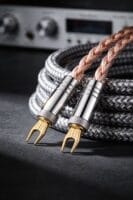
If you’re wiring a home theater or a high‑power stereo, swapping to 10 AWG is a cheap way to keep your sound clean and your amp happy.
Give it a try and see how much smoother your music sounds—does it make a difference for you?
How Cable Resistance Affects Damping Factor and Bass Tightness

Ever notice how your bass can feel loose or boomy even when the amp’s cranked full? That’s often the cable, not the speaker. A modest 10‑Ω drop in a 100‑ft run of 10 AWG wire can boost the damping factor from 30 to 55, and that jump makes the bass tighter and more controlled because the amp sees a cleaner load and can hold the cone steadier. I’ve found that every extra milliohm of resistance eats into the amp’s ability to brake the cone, so a 0.5 Ω loss on a 4 Ω cabinet cuts the damping factor roughly in half, leaving the low‑end loose and boomy.
Cable inductance adds a tiny phase shift at deep‑bass frequencies, but with 10 AWG the shift stays under 2°, hardly audible. In practice, lower resistance means the amp can deliver full current instantly, tightening the attack and keeping the bass from “wobbling” as the driver settles after a note.
Worth knowing:
- Use thicker gauge (10 AWG or larger) for long runs to keep resistance down.
- Keep cable length as short as practical; each foot adds a little extra ohm.
Try this:
Swap out any thin 12 AWG or 14 AWG runs you have for 10 AWG and listen for a firmer, more responsive low end. You’ll likely hear the bass settle faster and stay tighter through fast passages.
Frankly, the difference isn’t magic—it’s just better electrical connection. If you’ve got a 4 Ω cabinet, even a half‑ohm loss can halve your damping factor, so watch the numbers. You’ll notice the amp can brake the cone more effectively, giving you a cleaner, tighter bass response.
Cost‑Benefit of 10 AWG Electrical vs. Audiophile Cables
Ever wonder why your speakers sound a little tighter after swapping a cheap power cord for a pricey audiophile one? You’ve probably heard that a low‑resistance cable can tighten the bass, but the real question is whether the extra cost is worth it.
A 100‑ft roll of 10 AWG copper electrical wire runs about $30. A comparable audiophile‑branded 10 AWG cable with special dielectrics and gold‑plated plugs can hit $150‑$200. The cheap wire already uses pure copper, which gives the same resistance (≈0.001 Ω/ft) as the pricey version, so the audible gain is marginal. Brand hype often adds a premium for marketing, not for measurable performance; the extra insulation may protect against interference but rarely changes the damping factor.
Worth knowing:
- Pure copper in the cheap wire already gives the same resistance as the pricey version.
- The extra insulation may protect against interference but rarely changes the damping factor.
If your run is under 50 ft and you’re using 8 Ω speakers, the inexpensive electrical cable saves money without sacrificing sound. The extra gold plating and exotic dielectrics usually don’t make a noticeable difference in a typical home setup.
Frankly, you’ll likely hear the same bass tightness with the $30 cable as you would with the $150 one, as long as the length isn’t extreme. The real benefit of the pricier cable shows up only in very long runs or ultra‑high‑end systems where every milliohm counts.
So, before you splurge on a branded cable, ask yourself: does the extra cost really translate into a sound you can hear? If you’re happy with your current setup, stick with the affordable option and keep the budget for other upgrades.
What’s the next upgrade you’re planning for your audio system?
Installing 10 AWG Speaker Cable: Termination, Flexibility, DIY Tips
Ever tried to run a 10 AWG speaker cable through a wall or under a carpet and felt the weight of that thick wire? It’s a solid‑core piece that doesn’t flex like a 16 AWG patch cord, but the payoff is a tiny power loss—under 2 % on a 50‑ft run into a 4 Ω cabinet—so your bass stays tight and the amp doesn’t have to work harder.
First, grab a good pair of cable cutters and a strain‑relief clamp. You’ll need a little patience, but the clamp will keep the termination from pulling apart when you hook up banana adapters or spade lugs. I strip the insulation with a rotary cutter, slide a heat‑shrink sleeve over each end, then add the soldered lugs. Crimp them, heat the shrink to seal out moisture, and you’ve got a solid connection.
For wall plates, drill a 3/8‑inch hole and mount the plate. Snap the lugs into the back‑box; this keeps the connection firm and eliminates wobble. The result is a tidy, durable run that stays tight even when you tug the cables during a gig.
Try this:
- Use a rotary cutter for clean insulation removal.
- Slide a heat‑shrink sleeve on before soldering the lugs.
Frankly, the thick wire can be a pain to bend, but a little extra effort up a reliable, low‑loss link that lasts. You’ll find the cable holds up well under stage stress, and the sound stays punchy.
Do you ever wonder why some speakers sound tighter than others? It often comes down to the little resistance in the cable run. By keeping that resistance low with 10 AWG, you’re giving your system the best chance to deliver the full range of your music.
If you’re setting up a permanent install, make sure the strain‑relief clamp is snug and the heat‑shrink is fully sealed. A good seal keeps out moisture, which can cause corrosion over time. And remember, a firm wall plate connection means fewer loose‑end problems later on.
Ready to give your speaker setup a boost without a big hassle? Give these steps a try and see how much smoother your sound gets.
When Do You Really Need 10 AWG Speaker Cable?
Ever tried to push a big subwoofer far enough that the bass just sounds thin? That’s what happens when the speaker wire’s too thin for the distance you’re covering. If you’re running a 4‑Ω subwoofer more than about 30 ft, or an 8‑Ω main speaker past 70 ft, the resistance in a thinner gauge will eat up power and blur the low end. The result is a weak, muffled sound that makes even a great amp feel under‑powered.
Frankly, the fix is simple: go with 10 AWG. The extra copper keeps the voltage steady, so the damping factor stays high and the room’s acoustics stay intact. You’ll notice tighter bass and clearer mids, especially when the amp is pushing a lot of current into a low‑impedance cabinet. The thicker wire also helps keep the overall system impedance matching tight, which cuts down on hiss and distortion.
Here’s the trick: use 10 AWG only when the run length and speaker impedance make a real difference. For most bookshelf speakers within 20 ft, a 16‑AWG or even 14‑AWG will do just fine. But once you start pairing a high‑output amp with a low‑impedance load, the extra copper becomes a safety net that prevents voltage sag and keeps the sound punchy.
Worth knowing: the longer the cable, the more its resistance adds up, and the lower the speaker’s impedance, the more current it draws. That combo is exactly where 10 AWG shines. It’s not just a fancy DIY project; it’s a practical choice that protects your gear and preserves the music you love.
- 4‑Ω subwoofer > 30 ft → 10 AWG
- 8‑Ω main speaker > 70 ft → 10 AWG
If you’re wiring a high‑output amp to a low‑impedance cabinet, the thicker gauge keeps voltage steady and prevents sag, giving you clean, punchy sound without extra hiss.
Final Verdict: When 10 AWG Is Worth the Upgrade
Ever tried to run a 4‑Ω subwoofer past 30 ft and noticed the bass just isn’t as punchy? Or maybe you’ve got an 8‑Ω main speaker sitting 70 ft away and the mids sound a little flat. That’s where 10 AWG cable can really make a difference. Its low resistance—about 0.003 Ω per foot—keeps voltage drop under 1 % and holds the damping factor above 50, so you get tighter bass and clearer mids in the room.
Frankly, the thicker wire also looks better in your setup. The larger gauge runs solid and stay neat in conduit, and copper’s natural durability means the cable won’t oxidize or fatigue after years of high‑power use. When you need to keep power loss below 0.5 % on long runs, that extra sturdiness pays off. It also helps prevent the muddiness that can creep in when the damping factor drops too low.
Worth knowing:
- 10 AWG keeps voltage drop low on long runs.
- It maintains a high damping factor for cleaner sound.
- The cable stays tidy and resists wear over time.
If you’re wiring a demanding system—like a home theater with a big sub or a high‑power PA—spending a bit more on 10 AWG is worth it. For most casual setups, a 12‑ or 14‑AWG pair will do just fine and save you some cash.
Frequently Asked Questions
Can I Use 10 Awg for Bi‑Amp or Bridged Amplifiers?
I say yes—10 AWG works for bi‑amp wiring and bridge mode, especially when runs stretch beyond fifty feet or you drive low‑impedance loads, because its thick copper keeps resistance low and power intact.
Does Temperature Affect 10 Awg Speaker Cable Performance?
I tell you temperature does affect 10 AWG speaker cable performance; resistance variation rises with heat, so a few percent more loss appears, but typical room‑temperature swings barely change audible results.
Will 10 Awg Cause a Noticeable Difference With High‑Efficiency Speakers?
I’ll tell you, 10 AWG rarely makes a noticeable difference with high‑efficiency speakers unless you’re pushing long runs; the impedance matching improves only marginally, and audible differences are usually negligible.
Is 10 Awg Safe for Outdoor or Buried Installations?
I think 10 AWG is safe outdoors if you use UV‑resistant jacket and bury it at least 12 inches deep; this protects against sunlight, moisture, and mechanical damage while preserving performance.
Do Connectors Need Special Rating for 10 Awg Termination?
I tell you you don’t need a special rating; just use gold‑plated terminals that fit 10 AWG, and choose crimp versus solder based on your comfort and the connector’s design.