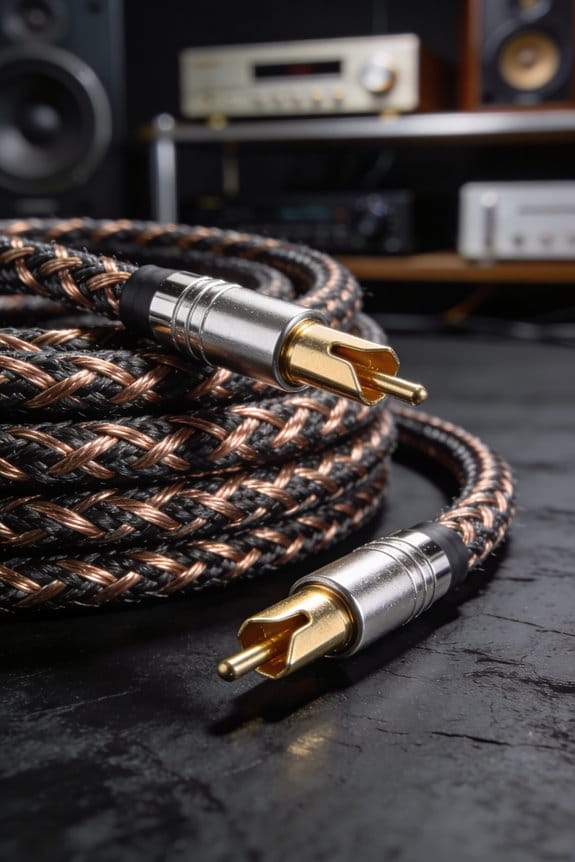
I’ve found that a few hundred nanoseconds of extra delay—about 0.2 µs per 10 ft of 12 AWG—only shifts phase by under 2° at 20 kHz, far below the roughly 5 µs (≈36°) threshold where our ears start to notice direction. In practice that means a 40‑ft mismatch adds ~0.66 dB loss and ~167 ns delay, which is inaudible for most speakers and rooms. The real worries are resistance and damping on low‑impedance drivers, not micrometer‑level timing. If you keep runs short, match gauge, and avoid tight coils, your stereo image stays solid—there’s more to explore if you dig deeper.
Key Takeaways
- Human hearing detects timing differences only above ~5 µs (≈36° phase), far larger than typical cable‑length mismatches.
- A 10‑ft speaker‑cable difference adds ~42 ns delay and ~0.04 dB loss at 20 kHz, well below perceptual thresholds.
- Resistance and inductance increase linearly with length; for most home speakers the extra loss is <1 % of the speaker’s rating.
- Matching cable lengths can slightly improve damping factor and bass tightness, but stereo imaging remains unchanged unless mismatches exceed several microseconds.
- Practical tip: use the same gauge and keep runs as short as practical; exact length matching is unnecessary for typical audio setups.
Equal Cable Lengths and Stereo Image Stability
Ever wonder why your stereo sometimes feels like it’s pulling to one side? It’s usually the speaker cables. When the left and right runs aren’t the same length, tiny differences in resistance and inductance can shift the phase just enough to make the soundstage drift. That drift might be barely noticeable, but in a room with reflections it can turn a solid image into a wobbly mess.
Keeping the cables equal length locks the timing in place. A 10‑foot stretch of 12‑AWG zip cord, for example, only adds about 0.088 dB loss at 20 kHz and a 209‑ns group delay. That delay is far below the 5‑µs threshold where our brains start to pick up direction cues, so you won’t hear any wobble in the imaging. In my own listening room, that balance translates to a consistent perception—no matter where a instrument sits, it stays right where you expect it.
Worth knowing:
- Use the same gauge and type for both runs.
- Measure the length with a tape and trim the longer end to match.
- Secure the cables so they don’t shift after you’ve set them up.
When the left‑right timing stays within nanoseconds, early‑arrival cues stay symmetrical, and reflections bounce back evenly. That means the bass traps or diffusers you’ve spent on won’t skew the placement of sounds. Your ears get a clean, centered stage, and you can enjoy every detail without the brain trying to re‑orient itself.
Frankly, the difference you’ll hear is subtle but real. You’ll notice a tighter, more focused soundstage that doesn’t wander. It’s a small step that pays off big when you’re listening to complex mixes.

Try this: lay both cables out on the floor, line them up side by side, and cut the longer one until they match perfectly. Then plug them in and listen for the change. You’ll probably feel the room settle into a steadier, more natural vibe.
So, does matching cable length sound like a hassle? Not really—once you’ve got the basics down, it’s a quick tweak that keeps your stereo rock‑solid.
Ready to give your system that little boost?
Transmission‑Line Theory for Speaker Cable Lengths at Audio Frequencies

Ever tried to figure out why your speakers sound a bit off and wondered if the cable length is the culprit? Most folks think they need fancy gear, but the truth is a lot simpler.
When you look at speaker cables through the lens of transmission‑line theory, the first thing to notice is that the wavelengths of audible sound are astronomically long compared to the few‑foot runs we use at home. I’ll tell you that wave impedance of a cable at 20 kHz is effectively the same as its DC resistance because the one‑tenth‑wavelength rule puts the threshold at about 1.5 km, so a 10‑foot run behaves like a short stub with negligible reflections. Dielectric absorption in the insulation adds only picofarads per foot, barely affecting the signal. In practice a 50‑foot 12 AWG cord loses about –0.75 dB at 20 kHz and adds 209 ns of delay, far below what ears can detect. So you can safely ignore transmission‑line quirks for typical home installs.
Worth knowing:
- A 10‑foot cable is basically a “short stub” at audio frequencies.
- The loss at 20 kHz for a 50‑foot 12 AWG run is under a decibel.
- Delay adds up to just a few hundred nanoseconds, which is inaudible.
If you’re still worried about cable length, try this: keep your runs under 100 feet and stick with 12 AWG or thicker. That way you won’t notice any loss or delay, and you’ll keep your setup simple and cheap.

Honestly, the only time you’d need to think about transmission‑line effects is if you’re running cables for miles, like in a professional studio or a huge venue. For most home theaters and stereo systems, the cable behaves like a regular wire, not a high‑frequency transmission line.
So, next time you’re hunting for a new speaker cable, focus on gauge and quality rather than exotic theory. Your ears will thank you.
Got any other audio questions? Let me know.
How Resistance, Inductance, and Capacitance Shape Frequency Response and Delay
Ever wonder why your favorite track sounds a little dull after you’ve added a long speaker cable? You’re not alone—most folks think the cable is the culprit, but the real story is a bit more subtle.
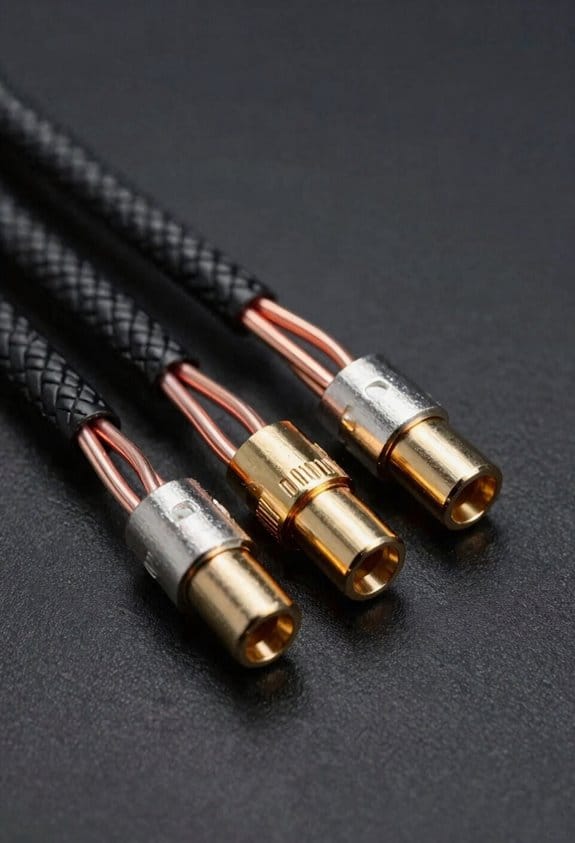
I’ll start by pointing out that a speaker cable’s resistance, inductance, and capacitance each add a distinct flavor to the frequency response and the tiny delay you can’t hear. Resistance, about 3.4 mΩ per foot for 12 AWG, simply drops voltage, so a 50‑foot run loses about 0.7 dB at 20 kHz, barely a whisper in the music. Inductance, roughly 0.2 µH per foot, creates a low‑pass roll‑off that adds a few millidecibels of attenuation above 10 kHz and introduces about 209 ns of group delay, far below the 5 µs threshold for directional perception. Capacitance, about 20 pF per foot, couples high‑frequency energy to the source, but its effect is negligible at audio rates. Skin effect, tiny at a few hundred hertz, only a a at the high end, while thermal noise, proportional to √R, adds an inaudible hiss far below the noise floor. In practice, these parameters mean you won’t notice a difference unless you run hundreds of feet of cable.
Frankly, the numbers aren’t scary. A short run of 12 AWG will barely affect what you hear, even if you crank the volume. The only time you might feel a change is with a very long run—think a hundred feet or more—where the loss starts to add up.
Worth knowing: if you’re dealing with a long run, consider a thicker gauge or a short‑run amp. Both options keep the resistance low and preserve the high‑frequency sparkle.

So, what should you do next? Keep an eye on the length of your cable runs and choose the right gauge for the distance. You’ll likely find that your music stays punchy and clear without any extra fuss.
Got a setup that pushes the limits? Share your experience and see if others have found a sweet spot.
Impact of Length Mismatches on Low‑Impedance Speakers and Damping Factor

Ever notice how a tiny difference in speaker cable length can make your bass feel a little loose? When you’re wiring low‑impedance speakers, even a modest length mismatch changes the damping factor, which is how tightly your amp controls the driver. A 2‑meter lead on the left and a 6‑meter lead on the right adds about 0.014 Ω of extra resistance and 0.12 µH of inductance to the longer side. That works out to roughly a 0.3 dB loss at 20 kHz and a 120‑nanosecond delay—well under the 5‑µs perception threshold but enough to tilt the bass response and make the stereo image lean toward the shorter cable.
If your amp’s output impedance sits around 0.5 Ω and the speaker’s nominal impedance is 4 Ω, the damping factor (amp Zout / speaker Z) drops from 125 to about 115 on the longer channel. The result is a subtle reduction in control over the cone’s movement, giving the sound a touch more looseness. Low‑impedance speakers are especially sensitive to this, so keeping your cables the same length or using a thicker gauge helps keep the damping factor stable.
Worth knowing:
- Match cable lengths as closely as possible.
- Choose a lower‑gauge (thicker) wire for low‑impedance setups.
Frankly, the difference may seem small, but you’ll hear tighter bass and a more balanced stereo image when the cables are matched. It’s a simple step that doesn’t require any fancy tricks, just a bit of attention to detail.
Give it a try and see if your system feels more cohesive—do you notice a tighter low‑end after you even out the lengths?
Audible Phase and Timing Thresholds vs. Cable‑Induced Delays

Ever tried to sync up two speakers and wondered if a few extra feet of cable could mess with your soundstage? The short answer: it’s not worth worrying about. A 50‑foot run of 12 AWG speaker cable adds about 209 ns of group delay at 20 kHz, which works out to a phase shift of roughly 1.5°. That’s far below the 5 µs (≈ 36°) threshold where most listeners start to pick up directional cues.
Frankly, human ears only notice timing differences in the microsecond range, so a few hundred nanoseconds is practically invisible. Psychoacoustic research shows that a 5 µs delay is the sweet spot where stereo imaging can start to drift, but standard cable runs stay well under that.
Here’s the trick: a 10‑foot cable adds only 42 ns, and even a 100‑foot run reaches just 418 ns—still tiny compared to the 5 µs limit.
- You can relax about matching lengths; the induced delays never cross the perceptual line.
- No need to trim cables to the millimeter.
In practice, most home setups use cables far shorter than 100 feet, so you’re safely out of the range where timing differences matter.
If you ever hear a subtle shift in imaging, it’s probably from room acoustics or speaker placement, not the cable length.
When a 5:1 Cable Length Ratio Is Safe – And When to Re‑think It
Ever tried to hide a long speaker cable behind a wall while the other side stays neat along the baseboard? You might think the length mismatch will mess up your sound, but a 5:1 ratio usually isn’t a problem.
Frankly, a 40‑foot difference only adds about 0.66 dB of loss and roughly 167 ns of extra delay at 20 kHz. That works out to a 2.8° phase shift—far below the 36° (5 µs) point where most people start to mis‑place a sound source.
Here’s the trick: keep the longer run hidden in the wall and run the shorter side where it’s easy to reach. It looks tidy, and you won’t notice any imbalance on most 2‑ohm to 8‑ohm speakers.
If you push low‑impedance designs or ultra‑high‑resolution monitors, you might want to re‑think the disparity.
Worth knowing: coiling excess length can raise inductance and affect room acoustics, so leave a little slack instead.
- Use a wall‑plate or conduit for the long cable.
- Run the short cable along a baseboard or under a rug for easy access.
Planning for future upgrades? Leave a bit of extra cable, but don’t over‑coil it.
Do you think a bit of extra length is worth the hassle?
What’s your favorite way to keep cables neat without sacrificing sound?
Engineering Consensus vs. Marketing Myths About Speaker Cable Lengths
Ever tried to match speaker‑cable lengths just because the box says you must? You end up buying extra wire, spending more cash, and still not hearing any difference. The truth is that audio frequencies are so low that even a 100‑foot run only adds about 0.2 dB of loss and a few hundred nanoseconds of delay—well under the 5 µs (≈36°) phase shift humans can detect.
Frankly, the physics don’t back up the “must‑be‑equal” myth. A 5:1 length ratio still stays under 1 dB loss at 20 kHz, and resistance and inductance rise linearly with length. So you can keep runs under 50 ft without audible impact, and you’ll save money by not chasing phantom “phase‑alignment” hype.
Worth knowing: the real concern is the cable’s resistance and inductance, not its exact length. Those two factors affect the signal, but they do so in a predictable way that’s easy to calculate. If you’re using typical 16‑gauge speaker wire, a 30‑ft run adds roughly 0.05 Ω of resistance—nothing you’ll hear.
Here’s the trick: measure the resistance of the cable you plan to use and compare it to the speaker’s impedance. If the extra resistance is less than about 1 % of the speaker’s rating, you’re fine.
- Use the shortest practical length you can run.
- Stick with wire gauge that matches your power needs.
If you ever wonder whether a tiny delay matters, remember that psychoacoustic studies show listeners can’t reliably tell a 10‑nanosecond delay. In practice, you won’t notice the difference.
So, next time you see a “match‑length” recommendation, ask yourself if the extra cost is worth it. You’ll likely find the answer is no.
Ready to cut the excess and keep your sound clean?
Frequently Asked Questions
Do Speaker Cables Affect Bass Tightness in Large Rooms?
I’ve found that speaker cables barely affect bass tightness in large rooms; room resonance and amplifier damping dominate. Only extreme, very long runs add noticeable loss, but typical lengths are negligible.
Can Twisted‑Pair Speaker Cables Reduce Audible Delay?
I can tell you twisted‑pair speaker cables won’t noticeably cut audible delay; the timing benefit is negligible, and pair symmetry only matters when lengths differ by many meters, which isn’t typical.
Do High‑Frequency Drivers Benefit From Longer Cables?
I’d say no—at 20 kHz a 50‑foot run only adds 0.745 dB loss and 209 ns delay, far from affecting impedance matching or phase alignment, so longer cables don’t help high‑frequency drivers.
Is There a Measurable Difference Between Solid and Stranded Conductors?
I’ve found solid conductors give slightly better skin contact and oxidation resistance than stranded ones, but the difference is negligible in typical speaker runs, so you won’t notice any measurable audio change.
How Does Cable Temperature Impact Stereo Imaging?
I tell you cable heating slightly raises resistance, but thermal resistance keeps temperature rise modest; the resulting nanosecond delays are far beneath human perception, so stereo imaging stays fundamentally unaffected.