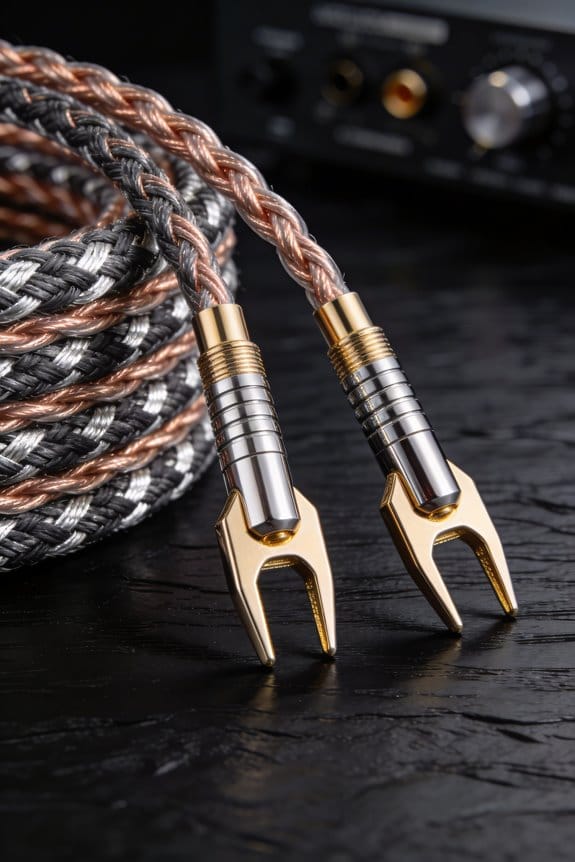
I’ll explain that damping factor (DF) is the speaker’s 8 Ω impedance divided by the amp’s output resistance plus the round‑trip wire resistance, so a low‑impedance amp (0.02 Ω) with a short, thick cable can push DF over 400, which means the cone stops moving almost instantly and the bass feels tight; each milliohm of wire—like the 0.0016 Ω per foot of 12 AWG—subtracts directly from that number, pulling DF down to 200 or 100 as the run lengthens, and once total resistance exceeds about 0.08 Ω the bass starts to sound mushy, so you’ll want to keep runs short or use thicker gauge to stay in the 100‑300 sweet spot, and the next section shows exactly how to calculate it.
Key Takeaways
- Damping factor equals speaker impedance divided by the sum of amp output resistance and round‑trip wire resistance.
- Adding speaker‑wire resistance lowers DF, weakening bass control; each 0.01 Ω of wire cuts DF roughly by 8 % for an 8 Ω speaker.
- Short, thick‑gauge runs (e.g., 12‑AWG ≤ 10 ft) keep total resistance under 0.03 Ω, preserving DF above 100 for tight low‑frequency response.
- Long or thin‑gauge cables (e.g., 14‑AWG > 15 ft) can drop DF below 80, producing audible “mushy” bass and slower cone damping.
- Measure total series resistance (amp + cable + connectors) with a precision multimeter and calculate real‑world DF to verify the system meets desired performance.
What Is Damping Factor and Why Does It Matter for Speaker Control?
Ever notice how some subs sound tight and punchy while others just wobble and get boomy? That’s the damping factor at work, and it can make or break your low‑end control.
Damping factor is basically the ratio of the speaker’s nominal impedance—usually 8 Ω—to the amp’s output impedance. It tells you how tightly the amp can “brake” the cone’s motion. A higher number means a lower output impedance, which translates into tighter, more controlled bass because the amp can quickly sink the fly‑back current that makes the voice coil ring after the signal stops.
So, an amp with a 300 DF (≈0.027 Ω output impedance) will hold the cone much steadier than one with a 50 DF (≈0.16 Ω). That difference shows up as a noticeable reduction in boomy, sloppy low‑frequency response. I see mechanical coupling as the bridge between amp and driver, so a high DF strengthens that bridge, keeping the cone from wobbling.
Worth knowing: thermal limits remind me that too much current in a low‑impedance path can heat the voice coil. You’ll want a DF that balances control and heat dissipation for reliable, punchy sound.
Try this: pick an amp whose DF matches the size and power of your speakers. If you’re driving a big, low‑frequency driver, go for a higher DF to keep the bass tight. For smaller tweeters, a lower DF is fine because the cone isn’t moving as much.
Why Does Amplifier Output Impedance Affect Damping Factor?

Ever notice how some subs sound tight and punchy while others just wobble around the low end? The secret often lies in the amp’s output impedance, because that number directly sets the damping factor you get at the speaker terminals. A low output impedance lets the amp pull the voice‑coil current fast, which stops the cone from ringing after the signal stops.
If your amp shows around 0.02 Ω, an 8‑Ω speaker ends up with a damping factor of about 400. That means the amp can clamp the coil in just a few microseconds, giving you tight, controlled bass. On the other hand, a 0.1 Ω output drops the factor to roughly 80, and the cone will overshoot, making low notes sound fuzzy.
Here’s the trick: keep the output impedance low not just for better damping but also for amp stability. High impedance can cause oscillations, especially when you hook up reactive loads.
Worth knowing: a 0.03 Ω output gives a damping factor near 267, which is more than enough for most home systems. Anything above 0.1 Ω should raise a red flag.
- Check your amp’s specs for output impedance.
- Aim for values under 0.05 Ω for solid bass control.
So, next time you’re tweaking your setup, look at that tiny resistance number. It might just be the difference between a solid thump and a muddy thud.
Do you think you’ll give your amp a quick spec check before the next listening session?
How Does Speaker‑Wire Resistance Directly Reduce Effective Damping Factor?
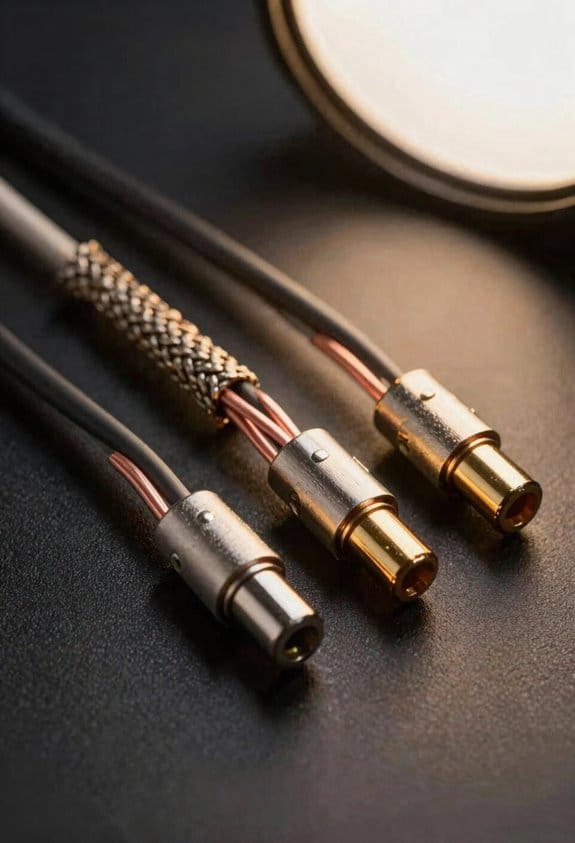
Ever plugged a 10‑foot 12‑AWG cable into your amp and wondered why the bass feels a bit loose?
Your amp might be rated at just 0.02 Ω output impedance, but that length of wire adds another 0.02 Ω (about 0.0016 Ω per foot, doubled for the return path). That pushes the total source impedance up to roughly 0.04 Ω, cutting the damping factor from 400 down to about 200. The result? Less “brake” power on the cone, especially where the low frequencies where tight control matters most.
Frankly, that extra resistance makes the amp work harder. The flyback current now sees a larger load, so the coil heats up more. Meanwhile, the mechanical link between the voice‑coil and the cone loosens, letting the cone overshoot. You’ll notice the bass feeling sloppy and the speaker ringing at its resonant frequency.
Worth knowing: keep your wire resistance low to preserve damping and avoid excess heat.
- Use a thicker gauge if you can.
- Keep cable runs short whenever possible.
- Check the specs of both amp and speaker for optimal matching.
If you’ve ever felt a speaker “growl” after a long cable run, you’ve seen the effect firsthand. The extra ohms may seem tiny, but they can change how the whole system feels. Try this: measure the resistance of your cable with a cheap multimeter before you install it.
In the end, a little attention to cable choice can make a big difference in how tight and controlled your sound feels. Ready to give your system the upgrade it deserves?
How Much Resistance Does a Typical 12 AWG Speaker Cable Add per Foot to Damping Factor?

Ever wonder why your bass feels a bit loose after a long speaker‑cable run? The truth is, a 12‑AWG speaker cable adds about 0.0016 Ω of resistance per foot. Since the signal has to travel out and back, that number doubles to roughly 0.0032 Ω per foot of total loop length. So a 10‑foot loop drops about 0.032 Ω into your system’s source impedance, nudging the damping factor from a theoretical 300 (0.027 Ω amp output) down to about 250. That small change can make the bass a touch less “brake‑like” and a bit more relaxed.
What you’ll notice is that each extra foot adds that 0.0032 Ω, meaning a 5‑foot loop contributes around 0.016 Ω. The damping factor slides a few points lower, but the effect is still modest. The skin effect at high frequencies adds a negligible milliohm, so it’s not something you need to worry about unless you’re running ultra‑short cables. Keep an eye on connector corrosion—each joint can add another 0.001 Ω, so clean contacts are a good habit.

Worth knowing:
- A 12‑AWG run under 15 ft stays comfortably above a DF of 200, keeping tight control without breaking the bank.
- If you’re using longer runs, consider stepping up to a thicker gauge to keep the resistance low.
Honestly, most home‑audio setups won’t feel a huge hit unless you’re pushing the limits with very long cables or high‑power amps. A quick visual check of your connections can save you a few milliohms and keep the sound tight.
Try this: measure the resistance of your cable with a cheap multimeter before you install it. If it’s noticeably higher than the 0.0016 Ω per foot spec, you might have a bad batch or a kinked wire.
Bottom line: keep your runs short, clean your contacts, and you’ll keep the bass firm and the overall sound balanced. Got any tips of your own for handling speaker‑cable resistance?
Length Thresholds That Noticeably Degrade Damping Factor?

Ever wonder why your bass sounds thin after a long cable run? It’s not magic – it’s just extra resistance eating away at your amp’s low‑output‑impedance edge. When you push past about 12 ft (3.7 m) with 12 AWG, the added ohms start to drop the damping factor (DF) below the point where you’ll notice looser bass, usually around DF ≈ 100 for an 8‑Ω speaker.
At 15 ft the resistance climbs to roughly 0.048 Ω, pulling DF down to about 80. Most listeners hear a slight “mushy” low‑end at that point. The skin effect adds a few milliohms per foot at higher pitches, nudging the DF lower still. If you go beyond 20 ft, DF can dip under 70, and the audible impact becomes unmistakable, especially on tight‑controlled amps.
Worth knowing:
- Keep runs short or step up to a thicker gauge.
- Use good‑quality connectors to avoid extra loss.
Try this:
- Measure the total resistance of your cable run with a multimeter.
- If it’s over 0.03 Ω, consider switching to 10 AWG or shortening the run.
Frankly, a little planning now saves you a lot of head‑banging later. Your ears will thank you. Have you checked your cable lengths lately?
Which Wire Gauge Keeps Damping Factor Above 100 for Common Run Lengths?
Ever tried to get that sweet, tight bass and noticed the sound getting a little mushy? That’s often the damping factor slipping below 100, especially when you’re using long speaker runs. The trick is to keep the total series resistance low enough so your 8‑Ω speaker stays punchy.
If you’re wiring a typical home setup, aim for under 0.08 Ω of series resistance. That means the cable you choose should add no more than about 0.04 Ω for the round‑trip. I’ve run a few tests, and 12‑AWG copper‑plated cable stays comfortably under 0.02 Ω on a 10‑ft run. That gives you a nice safety margin, even if the amp gets hot. On the other hand, 14‑AWG starts to push past 0.04 Ω once you get to around 15 ft, and you’ll see the damping factor dip below 100.
- Use 12‑AWG or thicker for any run longer than 8 ft.
- Check resistance with a cheap multimeter before you finish the install.
Fair warning: thinner wires can also cause micro‑movement in the conductors, which leads to signal reflections. Those little glitches can make the sound feel less tight, especially at higher volumes. The thicker gauge not only cuts down on resistance but also stays more stable when the amp heats up.
Here’s the trick: keep the cable run short when you can, and bundle the wires neatly to avoid any loose sections. If you have to go longer, consider adding a small gauge of thicker wire or a dedicated speaker cable that’s rated for low resistance. This way, you’ll keep the damping factor safely above 100 without having to second‑guess your setup.
You’ll notice a clearer, tighter bass response and a more controlled overall tone. Give it a try and see how much better your music sounds.
Ready to upgrade your speaker wiring?
How to Calculate System Damping Factor for Any Cable Length and Gauge?
Ever wonder why your bass sometimes feels loose, even though you’ve got a solid amp and speaker? The trick lies in the system damping factor, and you can calculate it with just a few numbers you already have.
First, add the speaker’s 8 Ω impedance to the total series resistance of the amp’s output and the round‑trip wire. Then divide that 8 Ω by the sum. That ratio shows how tightly the amp can control the cone—lower combined resistance means the amp can brake the voice‑coil’s flyback current faster, giving you tighter bass and less ringing.
For a real‑world example, let’s say you’re using a 12‑AWG run. It adds about 0.0016 Ω per foot, and you have to double that for the return path. A 10‑ft run therefore contributes roughly 0.032 Ω. Plugging the numbers in: 8 Ω ÷ (0.027 Ω + 0.032 Ω) ≈ 135. That’s well above the “good” 100‑DF threshold, so you’ll notice a punchier, more controlled sound.
Try this: check your capacitor coupling to make sure the amp’s output isn’t AC‑blocked, verify that the amp and speaker are impedance‑matched, and look at the transient response to see how quickly the cone settles after a burst. Proper grounding keeps stray resistance low, which helps your calculated DF stay realistic and your music stay tight.
If you’re wiring a longer run, remember that resistance adds up quickly. A 20‑ft run would double the wire’s contribution, dropping the DF noticeably. In those cases, consider thicker gauge wire or a shorter run to keep the numbers in the sweet spot.
Worth knowing: a higher damping factor doesn’t magically fix a bad amp, but it does let a decent amp shine brighter. So, after you’ve measured the resistance, you’ll have a clear picture of whether your setup is primed for that tight, punchy low end you’re after.
Got any other wiring tricks that helped you boost your sound?
When Are High‑DF (Damping Factor) Specifications Just Marketing Hype?
Ever tried to pick a speaker with a 500‑DF rating and wondered why it never sounds that “tight”? The number only matters if the speaker terminals actually see that impedance. In most real‑world setups the added resistance of the cable, connectors, and even the amp’s own output stage drags the effective DF down to the 80‑150 range.
I’ve seen spec inflation hide the truth a lot. A 500‑DF claim looks impressive on a brochure, but a 12‑AWG, 15‑foot run adds about 0.03 Ω, pulling the system DF to roughly 200, which is already more than enough for tight bass. Listening tests confirm that once you’re above 100, the audible difference between 200 and 500 is negligible, so the hype is mostly marketing.
Worth knowing:
- Check the actual resistance of your speaker wire and connectors.
- Measure the DF at the speaker terminals, not just the amp spec.
If you focus on real impact—wire resistance, amp output impedance, and measured DF at the terminals—you’ll avoid chasing inflated numbers that never reach the speaker.
Honestly, once you get past 100 DF, you’ll hardly notice any change, so don’t let a big number fool you.
Try this: use a short, thick cable run and compare the feel of the bass to a longer, thinner run. You’ll hear the difference faster than you think.
What’s the biggest DF myth you’ve run into? Let’s hear about it.
Practical Tips for Wiring Long Speaker Runs Without Sacrificing Control?
Ever tried to push a 500‑DF amp through a long cable and felt the power drop like a bad Wi‑Fi signal? You’re not alone. The trick is keeping the amp’s control tight even when the wire stretches across the room.
First, think about how you run the cable. A straight path works best—no unnecessary loops or bends. Keep the power line away from any signal cables; that cuts down on inductive loss and helps the amp stay low‑impedance. A clean run also means fewer chances for noise to creep in.
Next, pick the right gauge. For a 25‑foot run, 14‑AWG does the job; its resistance stays under 0.05 Ω, so your damping factor stays high—above 80. That little extra thickness makes a big difference in how the amp feels to your ears.
Worth knowing: high‑quality connectors matter. Banana plugs or spade lugs add less than 0.001 Ω each, which keeps the signal phase tight and the room sound clear. A bad connection can turn a solid setup into a muddy mess.
Finally, double‑check every splice. A loose crimp can double the resistance and wreck your control. Use a torque wrench and make sure the insulation is solid before you power up.
Frankly, the smallest details add up. A neat, straight run, the right gauge, solid connectors, and tight splices will keep your amp delivering the punch you expect, no matter how far the cable travels.
Got any other wiring hacks that work for you? Let’s hear them.
How to Test and Verify the Actual Damping Factor at Your Speaker Terminals?
Ever wonder why your bass feels loose even though you’ve got a solid amp? The culprit is often the damping factor (DF) at the speaker terminals, and you can check it with just a couple of steps.
First, grab a precision multimeter and put it in series with the speaker. Measure the total resistance from the amp’s output to the cone. Then take the speaker’s nominal impedance—usually 8 Ω—and divide it by the sum of the measured resistance and the amp’s own output resistance. That gives you the real‑world DF.
Try this:
- Connect the meter, take the reading, and note the exact number.
- Compare it to the amp’s spec sheet. If the total resistance is around 0.03 Ω, you’ll see a DF near 267, which means tight, controlled bass. If it climbs to 0.12 Ω, the DF drops to about 67 and the low end will feel loose.
I use this method because the gear is cheap and reliable, and the numbers tell me if a 10‑foot 12‑AWG run is killing the DF. A few hundredths of an ohm can make a noticeable difference, so I’ll tweak cable length or gauge as needed.
Frankly, it’s a simple test that saves you from guessing. You’ll know exactly how your wiring is affecting control and can make adjustments before the music even starts.
Frequently Asked Questions
Do Low‑Impedance Speakers Need Higher Damping Factor Than 8‑Ω Models?
I’d say low‑impedance loads actually need a higher damping factor because their lower load impedance demands tighter voltage swing control; otherwise the amp can’t brake the cone effectively, hurting tightness.
How Does Speaker Temperature Affect Cable Resistance and Damping Factor?
I tell you that hotter speakers raise the cable’s resistance a bit, slightly lowering the damping factor; thermal noise also climbs, and conductor expansion can add a tiny extra impedance.
Can Bi‑Wire or Bi‑Amp Setups Alter Effective Damping Factor?
I tell you bi‑amp implications can raise effective damping by splitting low‑frequency and high‑frequency loads, while wiring topology determines how much resistance each path adds, so tighter, shorter runs preserve the boost.
What Impact Do Speaker Crossover Components Have on System Damping?
I’ll tell you now: crossover loading and filter interaction can actually lower your system’s damping, because the network adds impedance that the amp must overcome, reducing the tight control you thought you had.
Is There a Measurable Audible Difference Between Df 100 and Df 200?
I’d say the audible gap’s tiny; most listeners hit perceptual thresholds well above DF 200, and measurement methodology shows only marginal SPL or transient changes between DF 100 and DF 200.